


 Cart
Cart
 sales@molnova.com



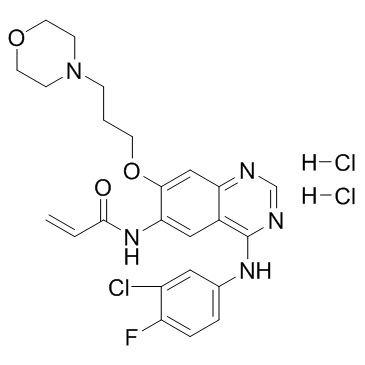
Canertinib dihydrochloride
CAS No. 289499-45-2
Canertinib dihydrochloride( Canertinib | CI-1033 dihydrochloride | PD-183805 dihydrochloride | CI1033 dihydrochloride )
Catalog No. M13886 CAS No. 289499-45-2
A potent, irreversible, orally available pan-ErbB inhibitor for EGFR and ErbB2 with IC50 of 7.5 nM and 9.0 nM in autophosphorylation assay.
Purity : >98% (HPLC)
 COA
Datasheet
HNMR
HPLC
MSDS
Handing Instructions
COA
Datasheet
HNMR
HPLC
MSDS
Handing Instructions
| Size | Price / USD | Stock | Quantity |
| 5MG | 29 | In Stock |


|
| 10MG | 43 | In Stock |
|
| 50MG | 61 | In Stock |
|
| 100MG | Get Quote | In Stock |
|
| 200MG | Get Quote | In Stock |
|
| 500MG | Get Quote | In Stock |
|
| 1G | Get Quote | In Stock |
|
Biological Information
-
Product NameCanertinib dihydrochloride
-
NoteResearch use only, not for human use.
-
Brief DescriptionA potent, irreversible, orally available pan-ErbB inhibitor for EGFR and ErbB2 with IC50 of 7.5 nM and 9.0 nM in autophosphorylation assay.
-
DescriptionA potent, irreversible, orally available pan-ErbB inhibitor for EGFR and ErbB2 with IC50 of 7.5 nM and 9.0 nM in autophosphorylation assay; displays no activity to PDGFR, FGFR, InsR, PKC, and CDK1/2/4; suppresses heregulin-stimulated tyrosine phosphorylation of erbB2, erbB3 and erbB4 with IC50 of 5, 14 and 10 nM, respectively, also inhibits expression of pp62c-fos in response to heregulin; shows high in vivo activity against A431 xenografts.Lung Cancer Discontinued.
-
In VitroCanertinib dihydrochloride (CI-1033 dihydrochloride) significantly inhibits growth of cultured melanoma cells, RaH3 and RaH5, in a dose-dependent manner. IC50 is approximately 0.8 μM and by 5μM both cell lines are completely growth-arrested within 72 h of treatment. Incubation of exponentially growing RaH3 and RaH5 with 1 μM canertinib accumulated the cells in the G1-phase of the cell cycle within 24 h of treatment without induction of apoptosis. 1 μM canertinib inhibits ErbB1-3 receptor phosphorylation with a concomitant decrease of Akt-, Erk1/2- and Stat3 activity in both cell lines.Canertinib dihydrochloride also is a potent activator of exosome secretion.
-
In VivoCanertinib dihydrochloride (CI-1033 dihydrochloride) shows superior in vivo antitumor activity, giving growth delays in A431 xenografts exceeding 50 days following oral administration. The growth of human malignant melanoma xenografts, RaH3 and RaH5, in nude mice is significantly inhibited by i.p. injections of 40 mg/kg/day canertinib. The anti-proliferative effect on melanoma xenografts is visible already within 4 days of treatment and further increased throughout the treatment period as observed through the differences in tumor volumes, reaching statistical significance within 18 days of treatment.
-
SynonymsCanertinib | CI-1033 dihydrochloride | PD-183805 dihydrochloride | CI1033 dihydrochloride
-
PathwayAngiogenesis
-
TargetEGFR
-
RecptorEGFR|HER2/ErbB2
-
Research AreaCancer
-
IndicationLung Cancer
Chemical Information
-
CAS Number289499-45-2
-
Formula Weight558.8603
-
Molecular FormulaC24H27Cl3FN5O3
-
Purity>98% (HPLC)
-
Solubility10 mM in DMSO
-
SMILESC=CC(=O)NC1=C(C=C2C(=C1)C(=NC=N2)NC3=CC(=C(C=C3)F)Cl)OCCCN4CCOCC4.Cl.Cl
-
Chemical Name2-Propenamide, N-[4-[(3-chloro-4-fluorophenyl)amino]-7-[3-(4-morpholinyl)propoxy]-6-quinazolinyl]-, hydrochloride (1:2)
Shipping & Storage Information
-
Storage(-20℃)
-
ShippingWith Ice Pack
-
Stability≥ 2 years
Reference
1. Smaill JB, et al. J Med Chem. 2000 Apr 6;43(7):1380-97.
2. Erlichman C, et al. Cancer Res. 2001 Jan 15;61(2):739-48.
3. Nyati MK, et al. Clin Cancer Res. 2004 Jan 15;10(2):691-700.
4. Slichenmyer WJ, et al. Semin Oncol. 2001 Oct;28(5 Suppl 16):80-5.
molnova catalog



related products
-
Alflutinib
Alflutinib (AST-2818, ASK120067) is a third generation EGFR mutation selective tyrosine kinase inhibitor.
-
Beta-Hydroxyisovaler...
Beta-Hydroxyisovalerylshikonin is an inhibitor of protein-tyrosine kinases such as v-Src and EGFR, and has been shown to induce apoptosis in several human tumor cell lines. Beta-Hydroxyisovalerylshikonin significantly decreased viability of HCT116 cells (IC50 values = 30.9 μg/mL).
-
Olmutinib
Olmutinib is a Novel Epidermal Growth Factor Receptor Tyrosine Kinase InhibitorOlmutinib at 3 μM significantly reversed drug resistance mediated by ABCG2, but not by ABCB1 and ABCC1, by antagonizing the drug efflux function in ABCG2-overexpressing cells.?
